Carr Golf Travel - Ireland and Scotland
GOLF ACCOMMODATION TRANSPORT ITINERARIES CORPORATE CARR FAMILY TESTIMONIALS EVENTS HELI-GOLF VIDEO CONTACT


CARR FAMILY

JOE (J.B.) CARR – A GREAT AMATEUR
There was a little green book on Joe Carr's coffee table entitled The Bruen Loop. Carr, who has three British Amateur titles to his name, three silver medals from the British Open and 38 assorted Irish championships, used the volume as a prop when the conversation turned to the idiosyncrasies of Irish swings of the not-too-distant past.

'The Irish,' began the septuagenarian Carr, 'are a very individualistic people….. Jimmy Bruen had his loop, Harry Bradshaw had a swing all of his own and so, too, did Philomena Garvey, arguably our best-ever Irish woman golfer.'
'My own swing,' he concluded, self-deprecatingly, 'was terrible - very short, very agricultural.'

Carr was already 31 and had played in three of his record 10 Walker Cup Matches when he decided to go to John Jacobs, one of the earlier golfing gurus and one who has stood the test of time. 'Hitters linger, swingers last,' said Carr by way of elaborating on why he and Jacobs worked on lengthening his action and eliminating what was at times something of a wild slash.

Though the results were immediately apparent, it was not until later that Carr really cashed in on the benefits of those changes.

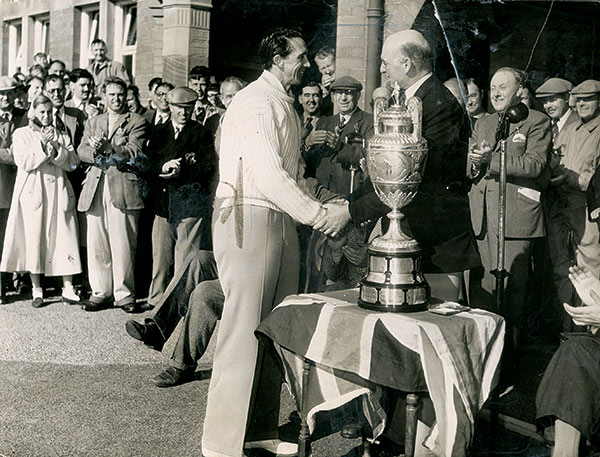
Having won his first British Amateur at Hoylake in 1953, when he defeated America's E. Harvie Ward Jr. by two holes in the 36-hole final, he thought he would bag the title again and again over the next few years. Instead, further triumphs proved elusive.

By the end of 1957, he was desperate. The 1958 championship was one he felt he had to win in that it was being held at St. Andrews. Before the end of '57, he studied the Old Course with a view of analysing precisely what it would take to win an Amateur over those rumpled fairways. What he learned was that he would need to drive well, to putt well - and to be in full control with the 8 and 9 irons.

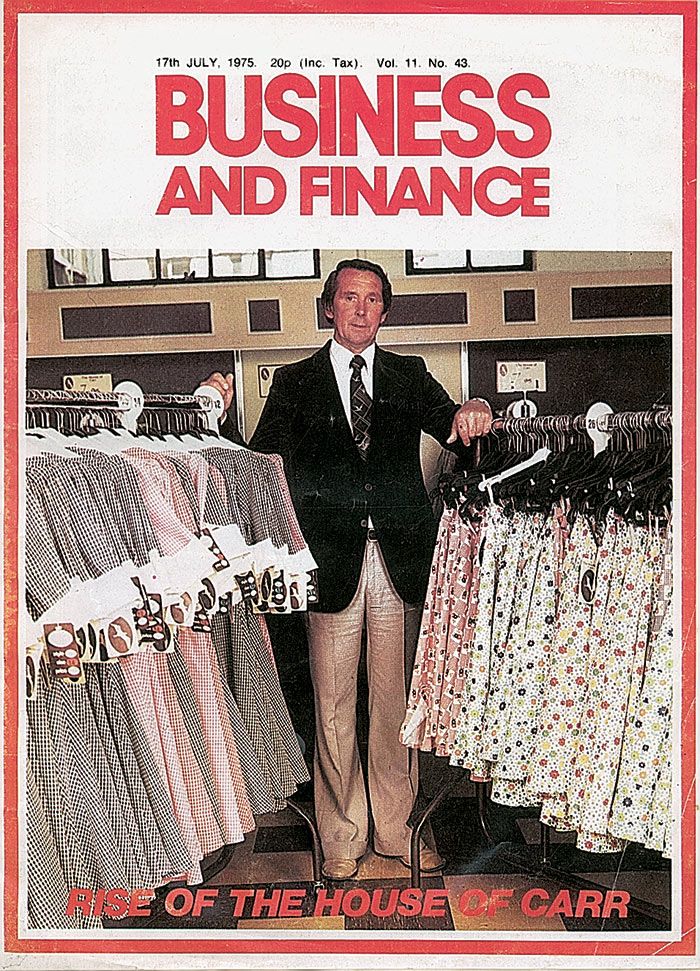
Eight months before the championship, Carr embarked on a daily routine that began at first light with a run along the sea-front while his regular caddie, Andy Doherty, lined up balls on the range at Sutton Golf Club. The early-morning practice stint was devoted solely to driving. After working during the day at his clothing business, he would devote the evenings to the irons, his session under makeshift floodlights being followed by night-time putting on the family carpet.

Before he took the boat to Scotland, he told his wife, Dorothy, with whom he would win nine Irish mixed foursomes championships, that he would come back with the title. 'No one else has done the work I have done,' he promised her. 'They can't beat me.'

He was right. Up until that week, there had never been more than 286 entrants for the Amateur. At St. Andrews, there were 488, none of whom troubled Carr. Ultimately, he defeated Alan Thirwell by 3 and 2 in the final.

The work he did for that week continued to pay dividends for three years. In 1959, he came within the proverbial whisker of winning the Dunlop Masters at Portmarnock from the professionals. Four ahead after three rounds, he played a last round in which the screams and cheers up ahead told their own story of how Christy O'Connor was in the throes of something rather special. In the end, O'Connor had a 66 to demote Carr to second place. By the same token, Carr was in contention at the 1960 British Open at St. Andrews until a storm led to the cancellation of a final round that he had started 3-4-4.

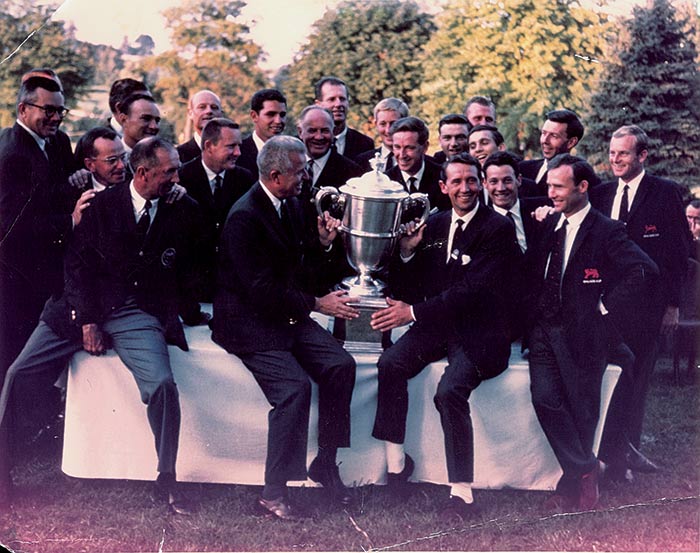
Because of his record, Carr would more often than not find himself playing at the head of the Great Britain and Ireland line-up in Walker Cup singles. As a result, he had a number of particularly tough matches against American leadoff players - a state of affairs that contributed to his Walker Cup record reading less impressive than his individual feats.

There were selectors who did not let him forget it and, shortly before the 1961 match in Seattle, Wash., the selectors in question, Gerald Micklem and Raymond Oppenheimer, sent a letter asking Carr if he would stand down and make way for younger men. A more-than-mildly irritated Carr, then 39, refused.
Carr laughingly recalls how, for the purposes of that match, he asked team captain Charles Lawrie if he could be played down the order for a change. Lawrie obliged and put him seventh, where his opponent turned out to be none other than Jack Nicklaus. Carr lost, 6 and 4.

The U.S. Amateur was played a week later at Pebble Beach. Nicklaus defeated Dudley Wysong in the final after Wysong had beaten Carr in the semi-finals. When Carr got back to Ireland, he penned a newspaper article in which he described Nicklaus as 'the best player the world will ever see.'

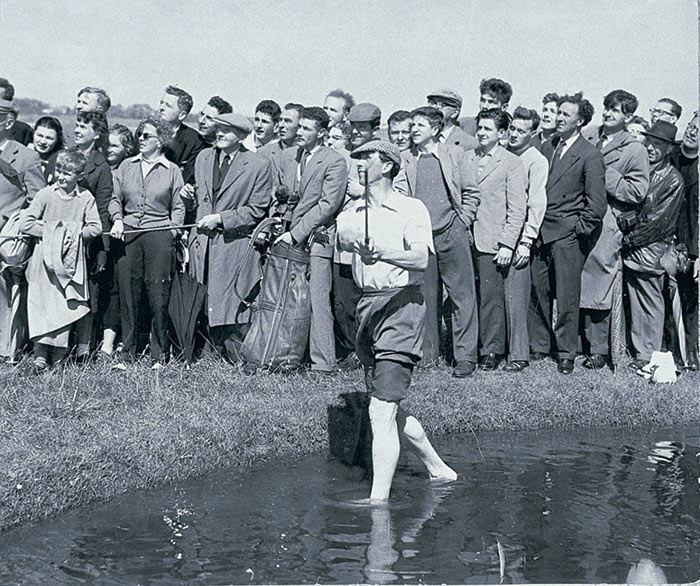
Of his Walker Cup successes, Carr picked out his singles match from the 1959 instalment at Muirfield as perhaps the most memorable. As the then British champion, he was once again up against his opposite number, this time Charlie Coe. Carr was 1 up with seven to play when, as the crowd surged between green and tee, someone stepped on his putter, snapping it in two. Carr putted with his 3-iron for the rest of the match, finishing off Coe by holing a 15-footer across the green of the 35th. So great was his confidence in that 3-iron that he continued to putt with it for the next three years.

When Carr started golf as a 10-year-old, he had an assortment of hickory clubs. Today, the names of yesteryear trip off his tongue like so many old friends - mashie, niblick, spoon, jigger. Through the years, the club that served him best was a 4-iron, 'the heaviest ever to come out of the John Letters factory.' John Letters himself had said to Carr that he needed a strong club to escape the rough, and the 4-iron fitted the bill for years. With it, Carr could hit the ball anywhere from 230 to 250 yards.

Now he uses a family of metal woods. He finds them very forgiving, yet he often wonders if modern technology has made as big a difference as some would have us believe. For instance, Carr held as many as 17 course records in his heyday, none of which has been beaten by more than a couple of shots in the ensuing years. 'Extraordinary,' he says, not boastfully but ruminatively, 'when you think about it. In my time we had inferior clubs, inferior balls, inferior greens, inferior everything.'

Carr nowadays wields a long putter, something for which he was lightly admonished by Michael Bonallack when, in 1991, Carr became the captain of the Royal and Ancient. 'You can't use that,' said his old rival. 'You're setting an appalling example to the young.'

He says that Bonallack, who beat him in the final of the Amateur at Troon in 1968, was the best putter he has ever known. When he lost to him at Troon, he remembers chastising Bonallack for holing '150 yards of putts.'

Today, Carr, whose popularity is reflected in the fact that he has been made an honorary member of some 60 clubs, plays to an 8 handicap. Two or three times a week he drives to Portmarnock, whose fairways he can see from his terrace above the sea. It was there, as the 10-year-old son of the club manager, that he first became interested in golf. In those days, the off-spring of a staff member was not allowed to become a member of the club; Carr joined Sutton, the nine-hole course along the road. As he progressed to the tournament arena, he entered all his championships from that little club.

In his youth, Carr would go out whatever the weather. Today he is a fair-weather golfer who, when he is playing 18 holes at Portmarnock, usually he uses a cart. He would prefer not to, but he has lung problems dating back to his smoking days. He will tell you that he used to smoke two or three cigarettes a hole, 'leaving them about all over the place.' Then, in 1974, he had a heart attack. The surgeon advised Carr that if he wanted to live longer than five years, he would need to cut out the cigarettes altogether. He stopped at once.

In his championship years, Carr used to find that the pressure of a week of 36-hole matches would cost him 10 or 12 pounds, which he could ill afford to lose. At 76, he has the same lithe build, his staple diet being the fish he collects each morning from the boats coming into the Howth harbour, not far from his home on Ireland's east coast.

His house, which shares a stretch of front wall with the old home of W.B. Yeats, the poet, is filled with pictures of the six children born to him by his late wife. Roddy was the best golfer among them winning 3 and a half points out of four in his Walker Cup appearance at St. Andrews in 1971.

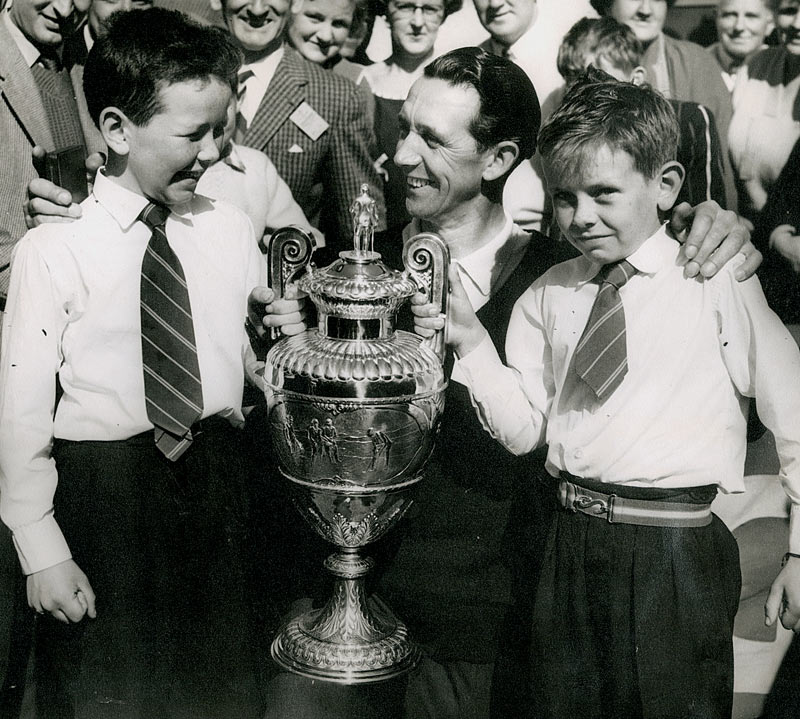
Shelf upon shelf in the lounge is taken up with Carr's trophies, which no doubt to the relief of his second wife and chief trophy cleaner, Mary, he is gradually giving back to the clubs who handed them out in the first place. Recently, he had news that one of the trophies he returned had been renamed the Joe Carr Memorial Trophy. Carr laughingly objected, saying that he would prefer them to wait until he was dead before they called it that.

The thinning out of the trophies is something Carr started in less-than-ideal circumstances when his career, relatively speaking, was in its infancy. At a time when money was short, he took cups off the shelves and sold them for £50. His Irish honesty is such that he never attempts to deny the story that he went out the next day and lost the lot, gambling.

Trophies and pictures alike bring back memories of an amateur career, the length and depth of which is very much a thing of the past. 'Today', he says, 'no one has the chance to put together a record like mine or Michael Bonallack's. They aren't around for long enough before they turn professional.'

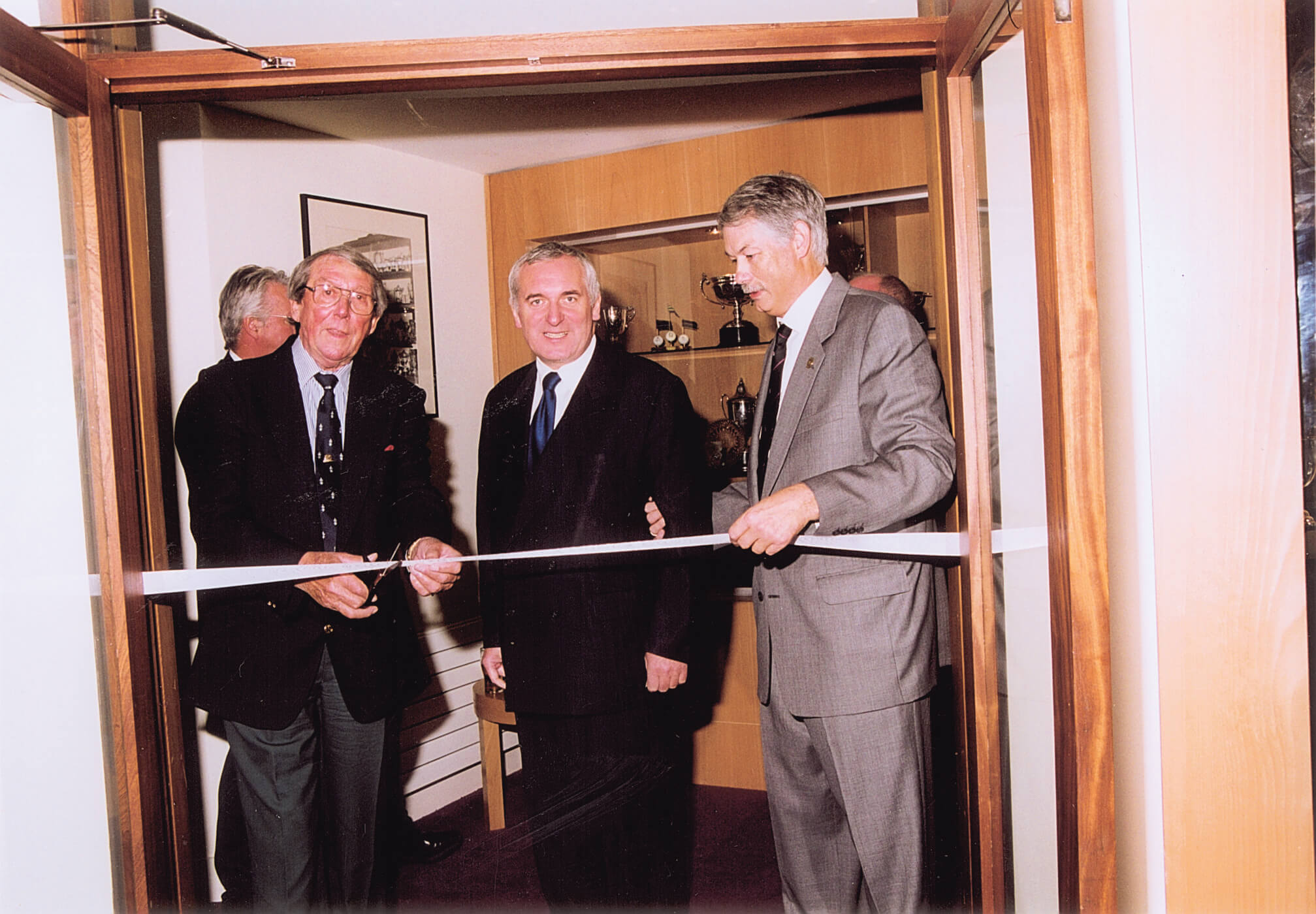
Joe Carr Room at Sutton Golf Club By the same token, he says that there is no time to build up the friendships that he would accumulate over years of Amateur Championships, Walker Cups and Eisenhower Trophies. He remembers long championship-week evenings spent putting for money against friends, and revelling in games of bridge, which were the norm after dinner. Indeed, there was one British Open Championship where he and Harold Henning offered to teach Nicklaus and Arnold Palmer the finer points of that card game, only to discover that the two great men were not compatible at a bridge table.

The course he has designed himself, Old Head at Kinsale Cork, asks different questions with a breathtakingly beautiful promontory furnishing 13 of the 18 holes with fairways rimming the cliffs. In the knowledge that he could never work with another site quite like it, Carr has refused to take on any further assignments.

He has heard it said that the course could be among the top 50 in the world. Yet, in the time-honoured conundrum, if he were asked to pick just one course where he could play the rest of his golf, it would be no contest. He would choose St. Andrews, scene of his '58 win and the course where, at one time, he held the course records on both the Old and New Course. He loves the way the elements conspire to have it play differently everyday. And he loves the fact that the one thing that remains the same is that Tip Anderson, the elderly caddie he has shared with Palmer, will be waiting for him outside the clubhouse the next time he arrives.


Lewine Mair writes about golf for The Daily Telegraph in London, England. Written by Golf Journal - January / February 1999.


  Should you request any information please fill out our ENQUIRY FORM  


Carr Golf Group, PO Box 6385, Dublin 15, Ireland
Toll Free: 1800 882 2656 enquiries@carrgolf.com Tel: 353 1 822 6662 Fax: 353 1 822 6668

Golf Courses in Ireland and Scotland - Hotels / Accommodation in Ireland and Scotland